



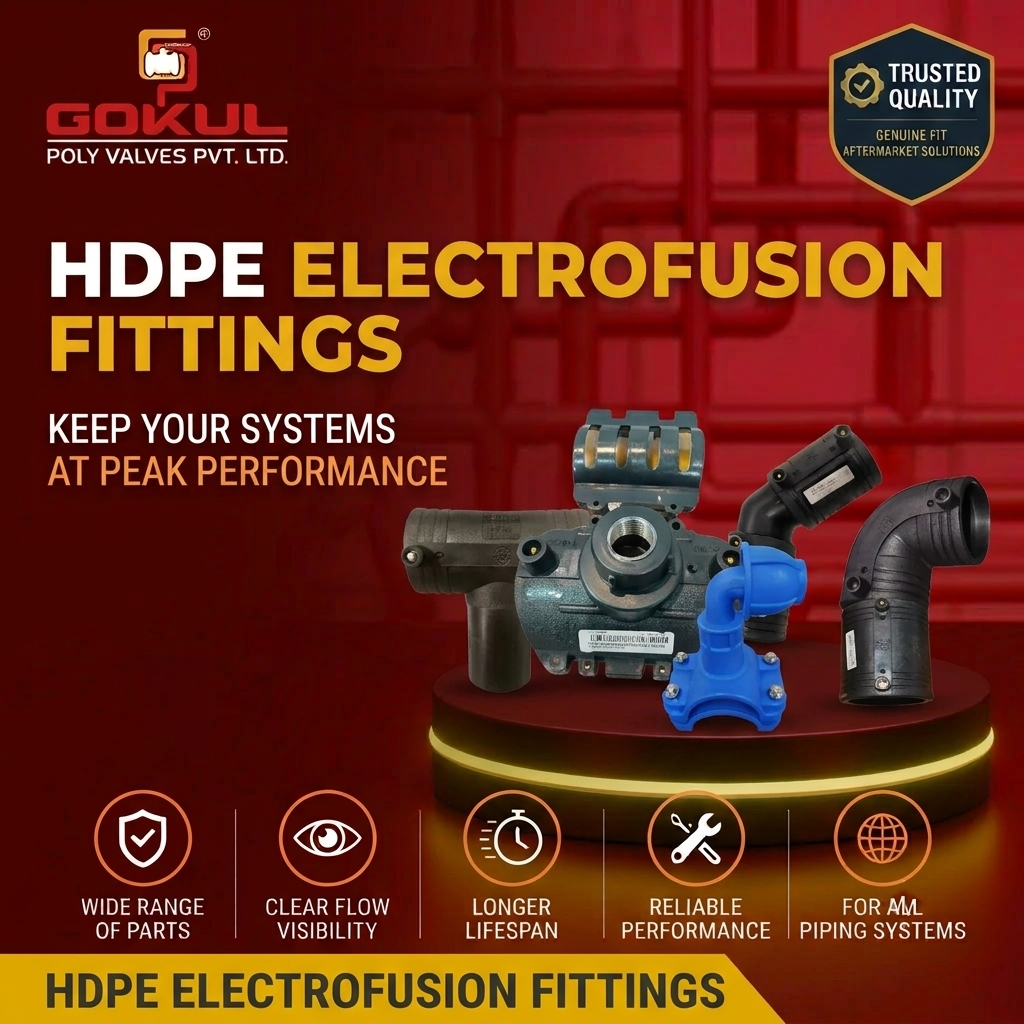
A pipeline is made up of more than just pipes. It also needs suitable connections to join pipe sections, change direction, create branches and close unused ends. Choosing the right fittings helps make installation easier and keeps the pipeline suitable for its intended use. HDPE Electrofusion Fitting is one option used to connect high-density polyethylene (HDPE) pipes through an electrofusion process.
This process involves passing electrical current through the heating elements contained within the fitting, causing the contact surfaces of both the fitting and the pipe to melt, thus forming a joint. When the joint has cooled down, then it forms a single jointed section. There are various types of fittings used for different pipeline designs; hence it is important to know about them.
Different Types of HDPE Electrofusion Fittings
Each fitting has a specific purpose. The right choice depends on the pipe size, connection point and layout of the pipeline.
01
HDPE Electrofusion Coupler
A coupler connects two HDPE pipe ends in a straight line. It is useful when joining separate pipe lengths or extending an existing pipeline. An HDPE Electrofusion Coupler is commonly used where a straight connection is needed without changing the direction of the pipe. Correct pipe preparation and alignment are important for a reliable joint.
02
HDPE Electrofusion Elbow
The pipeline may sometimes have to make a turn through walls or obstacles. This HDPE Electrofusion Elbow can be used to change the pipeline direction without compromising the continuous flow channel. The bend angle will be based on the pipeline design, which avoids any extra adjustments when installing the fitting.
03
HDPE Electrofusion Tee
The tee fitting serves as a branching point of the pipeline. It is beneficial when one needs to distribute water or any other compatible substance to other lines. Before fitting the tee, it is necessary to determine the branch size and flow requirements.
04
HDPE Electrofusion End Cap
An end cap closes the end of a pipe where the pipeline is designed to stop. It may be used at the end of a line or on a section that needs to be closed off. The cap must match the pipe dimensions and operating requirements of the system.
05
HDPE Electrofusion Saddle
A saddle provides a branch connection on an existing main pipe. Depending on its design, it can help create an outlet without replacing a long section of the main line. An HDPE Electrofusion Saddle must be compatible with the pipe and installed according to the manufacturer’s instructions.
06
HDPE Electrofusion Reducer
Not every pipeline uses the same pipe diameter throughout its length. A reducer is a joint that allows the connections between pipes of varying sizes, thus facilitating a change in the configuration of the pipe. Confirm the dimensions of the connections before using it.
07
HDPE Electrofusion Ball Valve
A ball valve regulates and stops the flow of the medium inside the pipeline. This particular type of ball valve allows it to be used in an appropriate HDPE system where the flow needs to be regulated.
How to Choose the Right Fitting for Your Pipeline
The selection of the fitting depends on knowing what the connection will do. The coupler is a connection fitting when straight pipe pieces have to be connected. An elbow fitting is appropriate if a directional change is needed. Tees and saddles are fitting types that enable a branch connection, while reducers are used where there are different sizes. Ball valves enable flow control.
Pipe size, materials compatibility, and pressures also have to be considered. When performing electrofusion welding, surfaces of the pipe and the fitting have to be properly prepared, and the heating procedure has to be done according to the instructions of the manufacturer of the fittings. The joint has to cool for the specified period of time.
For these requirements, GOKUL POLY VALVES PVT. LTD. offers a range of pipe fittings and valve products for different industrial and piping applications. Reviewing the available fitting types and their specifications can help you select products that match your pipeline layout
FAQs
An HDPE electrofusion fitting joins compatible HDPE pipes using heat generated by an electrical element inside the fitting.
A coupler joins two pipe sections in a straight line, while an elbow changes the direction of the pipeline.
Consider the pipe diameter, fitting type, pressure requirements, material compatibility and installation instructions before selecting a fitting.
Conclusion
Each type of pipeline requires specific connections, and having the right fittings can make all the difference. Whether it is straight joints, directional changes, branching connections, or flow control, each HDPE Electrofusion Fitting has a specific role. Knowing their differences will help you design your HDPE pipeline system and avoid connection issues.